


As a supplier of Absorption Towers, understanding how to calculate the absorption efficiency of these vital pieces of equipment is crucial. Not only does it help us provide accurate information to our customers, but it also allows us to optimize the design and performance of our products. In this blog post, I'll walk you through the process of calculating the absorption efficiency of an Absorption Tower, including the key factors involved and the equations you'll need.
Understanding the Basics of an Absorption Tower
Before we dive into the calculations, let's briefly review what an Absorption Tower is and how it works. An Absorption Tower is a type of mass transfer equipment used to separate one or more components from a gas mixture by transferring them into a liquid phase. This process is known as absorption, and it relies on the solubility of the target components in the liquid solvent.
The tower typically consists of a vertical column filled with packing material, which provides a large surface area for the gas and liquid to come into contact. The gas mixture enters the tower at the bottom, while the liquid solvent is introduced at the top. As the gas rises through the tower and the liquid flows downward, the target components in the gas dissolve into the liquid, leaving behind a purified gas stream at the top of the tower.
Key Factors Affecting Absorption Efficiency
Several factors can influence the absorption efficiency of an Absorption Tower, including:
- Solubility of the Target Component: The solubility of the target component in the liquid solvent is a critical factor in determining the absorption efficiency. Higher solubility generally leads to better absorption.
- Contact Time: The longer the gas and liquid are in contact, the more time the target components have to dissolve into the liquid. Increasing the contact time can improve absorption efficiency.
- Surface Area: The surface area available for mass transfer between the gas and liquid phases is another important factor. Packing materials with a high surface area can enhance absorption efficiency.
- Temperature and Pressure: Temperature and pressure can affect the solubility of the target component and the mass transfer rate. Optimal temperature and pressure conditions are typically determined based on the specific application.
- Flow Rates: The flow rates of the gas and liquid phases can also impact absorption efficiency. Properly balancing the flow rates is essential for achieving maximum performance.
Calculating Absorption Efficiency
The absorption efficiency of an Absorption Tower is typically expressed as the percentage of the target component removed from the gas stream. To calculate the absorption efficiency, you'll need to know the inlet and outlet concentrations of the target component in the gas phase, as well as the flow rate of the gas stream.
The following equation can be used to calculate the absorption efficiency ($\eta$):
[
\eta = \frac{C_{in} - C_{out}}{C_{in}} \times 100%
]
Where:
- $\eta$ is the absorption efficiency (%)
- $C_{in}$ is the inlet concentration of the target component in the gas phase (e.g., ppm, mol/m³)
- $C_{out}$ is the outlet concentration of the target component in the gas phase (e.g., ppm, mol/m³)
Let's look at an example to illustrate how this equation works. Suppose you have an Absorption Tower that is designed to remove carbon dioxide ($CO_2$) from a gas stream. The inlet concentration of $CO_2$ in the gas stream is 10,000 ppm, and the outlet concentration is 1,000 ppm. Using the equation above, we can calculate the absorption efficiency as follows:
[
\eta = \frac{10000 - 1000}{10000} \times 100% = 90%
]
This means that the Absorption Tower is able to remove 90% of the $CO_2$ from the gas stream.
More Detailed Calculations
In some cases, you may need to perform more detailed calculations to account for factors such as the material balance, mass transfer coefficients, and the height of the packing material. These calculations can be complex and may require the use of specialized software or engineering expertise.

One common approach is to use the overall mass transfer coefficient ($K_G$) to calculate the height of the packing material required to achieve a certain absorption efficiency. The overall mass transfer coefficient takes into account the resistance to mass transfer in both the gas and liquid phases.
The following equation can be used to calculate the height of the packing material ($Z$):
[
Z = \frac{G}{K_G a} \ln \left( \frac{y_{in} - y_{eq,in}}{y_{out} - y_{eq,out}} \right)
]
Where:
- $Z$ is the height of the packing material (m)
- $G$ is the molar flow rate of the gas phase (mol/m²·s)
- $K_G$ is the overall mass transfer coefficient (mol/m²·s·Pa)
- $a$ is the specific surface area of the packing material (m²/m³)
- $y_{in}$ and $y_{out}$ are the mole fractions of the target component in the gas phase at the inlet and outlet, respectively
- $y_{eq,in}$ and $y_{eq,out}$ are the equilibrium mole fractions of the target component in the gas phase at the inlet and outlet, respectively
Importance of Accurate Calculations
Accurately calculating the absorption efficiency of an Absorption Tower is essential for several reasons. First, it allows us to design and select the appropriate equipment for a given application. By knowing the required absorption efficiency, we can determine the size and type of Absorption Tower needed, as well as the appropriate packing material and operating conditions.
Second, accurate calculations help us optimize the performance of the Absorption Tower. By understanding the key factors that affect absorption efficiency, we can make adjustments to improve the efficiency and reduce operating costs.
Finally, accurate calculations are important for ensuring compliance with environmental regulations. Many industries are subject to strict emissions limits, and an Absorption Tower that is designed and operated correctly can help ensure that these limits are met.
Other Related Equipment
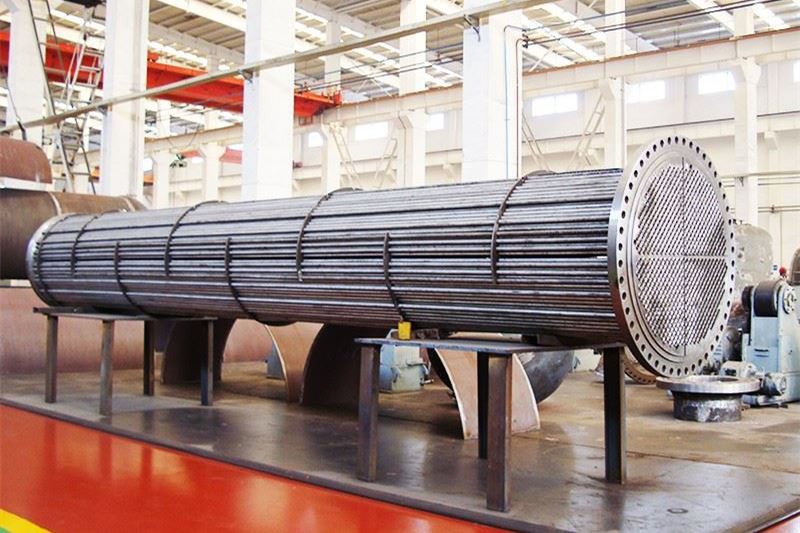
In addition to Absorption Towers, we also supply other types of pressure vessels, such as Fixed Tube Sheet Heat Exchangers and Storage Vessels. These equipment are often used in conjunction with Absorption Towers in various industrial processes.
A Fixed Tube Sheet Heat Exchanger is used to transfer heat between two fluids, while a Storage Vessel is used to store liquids or gases. By offering a comprehensive range of pressure vessels, we can provide our customers with a complete solution for their industrial needs.
Contact Us for Procurement
If you're in the market for an Absorption Tower or other pressure vessels, we'd love to hear from you. Our team of experts can help you select the right equipment for your application and provide you with detailed information on absorption efficiency calculations. Contact us today to start the procurement process and take the first step towards improving your industrial processes.
References
- Perry, R. H., & Green, D. W. (Eds.). (2008). Perry's Chemical Engineers' Handbook (8th ed.). McGraw-Hill.
- Treybal, R. E. (1980). Mass-Transfer Operations (3rd ed.). McGraw-Hill.


